
The Real Driver of Growth Most Businesses Miss
Most businesses believe marketing and advertising drive growth.
When results slow down, the instinctive response is to increase activity. More campaigns. More content. More advertising. Perhaps a new website.
Sometimes that activity produces a short burst of momentum.
But momentum is not the same as growth.
The real constraint behind most stalled growth is rarely marketing execution. It is something far more fundamental:
A lack of brand clarity.
→ Click here to try our free 10-minute Brand Clarity Scorecard for evaluation and expert recommendations. [Try It Now]
- Clarity about who the organisation serves.
- Clarity about the problem it solves.
- Clarity about why it deserves to be chosen.
Without this clarity, marketing becomes fragmented. Campaigns may generate attention, but attention without understanding rarely turns into long-term value.
With clarity, marketing becomes leverage. Every message reinforces the same idea, every campaign strengthens the same position, and every interaction makes the brand easier to understand.
This is the role of brand strategy.
Brand strategy exists to create organisational clarity.
What Brand Strategy Actually Does
Brand strategy is often misunderstood because it sits beneath the visible layer of a brand.
Most organisations associate branding primarily with logos, colours and typography. These elements form part of a company’s brand identity, the visual system used to express the brand.
But identity is not the brand itself.
It is simply the expression of something deeper.
Brand strategy defines the meaning that identity must communicate and the role the organisation intends to occupy in the market.
At its core, brand strategy answers three critical questions:
- Who is the brand built for?
- What space does it occupy in the market?
- Why should customers choose it over alternatives?
This is where brand positioning becomes essential.
Positioning determines how a brand is understood relative to competitors and the context in which customers evaluate it.
Without positioning clarity, marketing activity becomes disconnected from meaning. Campaigns may still generate engagement, but the brand itself remains indistinct.
Over time, indistinction has a cost.
Businesses without clear positioning often drift into competing on price or convenience because the market cannot easily identify a stronger reason to choose them.
Strategic clarity allows a brand to compete on relevance, expertise and authority instead.
Why Strategic Clarity Matters More Today
For decades, marketing advantage was largely driven by execution.
The companies that invested most heavily in advertising and marketing activity dominated attention.
That dynamic is changing.
Today, execution has become widely accessible.
- AI tools can generate websites, content and creative assets instantly.
- Marketing automation platforms run campaigns continuously.
- Design tools make professional visual production easier than ever.
The result is an explosion of marketing activity.
Entire websites can now be generated with AI. Social content can be produced automatically. Even tone of voice and personality can be replicated.
These technologies are powerful.
But they introduce a new problem.
If every organisation can produce marketing at scale, differentiation becomes harder.
Execution becomes commoditised.
This is why clarity is becoming one of the most valuable strategic assets a business can possess.
The brands that grow in modern markets are not the ones producing the most marketing.
They are the ones that are understood the fastest.
Clear brands win attention, trust and recall because their role in the market is immediately obvious.
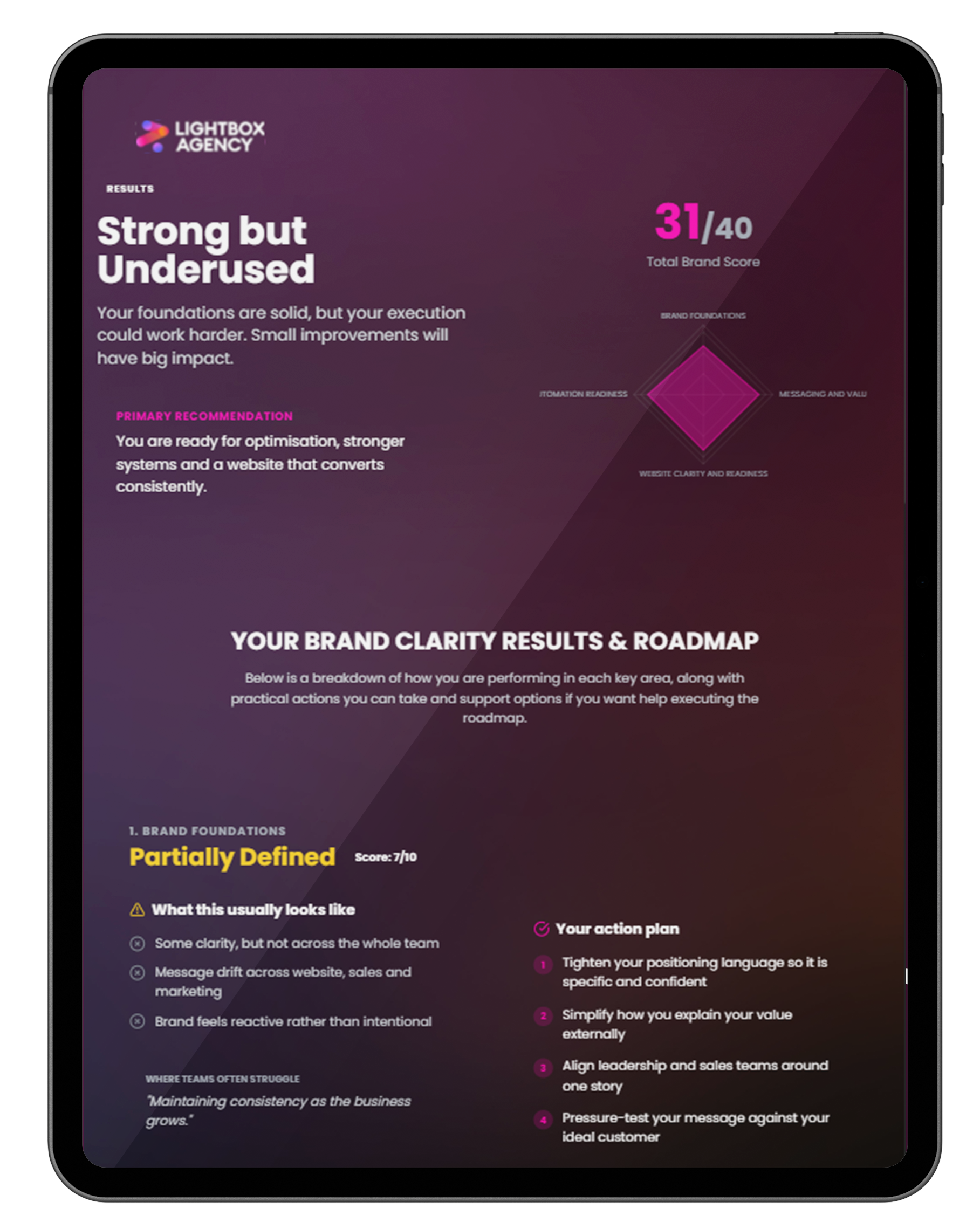
FREE RESOURCE
FREE RESOURCE
Here's what The 10-Minute Brand Clarity Scorecard does to benchmark and strengthen your brand:
 Determines positioning gapsSpots messaging gapsBenchmarks your brand strengthPinpoints high-impact fixes
Gain clarity for more focused, prioritised actions that will make the biggest difference to your brand.
Try It NowThe Clarity Stack
At Lightbox, we describe brand strategy through a framework called The Clarity Stack.
Most growth challenges can be traced back to a breakdown in one of these layers.
Market Clarity
Understanding the category you compete in and the role you intend to play within it.
Customer Clarity
Defining the audience you serve and the problems that matter most to them.
Positioning Clarity
Establishing why your organisation is uniquely valuable for that audience.
Narrative Clarity
Ensuring messaging consistently communicates that position.
System Clarity
Embedding strategy into marketing systems, processes and operations.
Each layer builds upon the one beneath it.
But positioning clarity is the most critical.
If positioning is unclear, messaging becomes generic. Marketing campaigns lose focus. Sales teams struggle to explain differentiation.
When positioning is clear, every layer above it becomes stronger.
Messaging becomes sharper. Marketing becomes more effective. The brand becomes easier for customers to understand.
Why Brands Lose Strategic Direction
One of the most common patterns we see in growing organisations is misalignment between the business and its brand.
Companies evolve.
- Markets shift.
- Capabilities improve.
- New opportunities emerge.
But the strategic rules that once guided the organisation often remain unchanged.
Over time, the brand direction no longer reflects the organisation’s mission, vision or markets.
The symptoms are easy to recognise.
- Sales teams struggle to explain differentiation.
- The website attempts to speak to everyone.
- Marketing activity becomes disconnected from the rest of the organisation.
In reality, the problem is rarely marketing.
It is that the brand strategy no longer reflects who the organisation actually is.
This is also why many rebranding projects fail.
Rebranding typically focuses on visual identity and messaging consistency. These elements matter, but they cannot fix a strategy that has drifted away from the market.
If the ideal customer has changed or the organisation’s unique solution is unclear, a new logo will not solve the problem.
Strategy must evolve before expression can.
Brand Strategy in Modern Digital Environments
The importance of clarity becomes even greater in digital ecosystems.
Modern marketing operates across websites, search engines, social platforms, AI assistants and CRM systems. Each of these environments processes information differently, but they all reward the same characteristic:
Clear expertise.
- Search engines prioritise structured knowledge.
- AI systems summarise information into concise answers.
- Algorithms favour brands that consistently communicate their role within a category.
Brands with clear positioning naturally produce clearer content, clearer messaging and clearer digital experiences.
This improves:
- Search visibility
- AI discoverability
- Content relevance
- Marketing efficiency
In other words, clarity is not only a human advantage.
It is also an algorithmic advantage.
Brands that are easy for people to understand are also easier for digital systems to interpret.
A Real Example of Strategic Ambiguity
In one recent case, a client believed their organisation was modern and progressive.
But the market perceived them as outdated.
The issue was not capability. It was inconsistency.
Different members of the team were targeting different audiences. Sales conversations varied depending on who was speaking. The messaging used online did not match how the company presented itself in marketing.
Prospects were confused about what the organisation actually offered and who it was built for.
Once the team clarified their positioning and aligned around their ideal customer, communication became consistent across sales, marketing and digital channels.
The organisation itself had not dramatically changed.
But its clarity had.
And that clarity made the business easier to understand and trust.
The Lightbox Philosophy
At Lightbox, we believe brand strategy exists to shape every action, message and belief within an organisation.
Not just externally in marketing, but internally as well.
Strategy informs:
- How teams make decisions.
- How products are developed.
- How marketing communicates.
- How sales explain value.
When strategy is clear, the organisation becomes aligned.
Marketing, sales and leadership reinforce the same narrative.
- Clarity drives alignment.
- Alignment drives consistency.
- Consistency builds trust.
- Trust drives growth.
What Happens When Strategy Comes First
When organisations clarify their brand strategy before investing heavily in marketing execution, measurable shifts occur.
Businesses that sharpen their brand positioning around a defined audience often experience:
- Higher quality enquiries
- Shorter sales cycles
- Stronger engagement with marketing content
Internally, teams become more aligned because everyone is communicating the same story.
Marketing becomes more efficient because campaigns reinforce a consistent strategic position rather than competing with one another.
A simple test illustrates the difference.
Can your organisation clearly explain why it is the best choice for its ideal customer without relying on generic claims like “great service” or “high quality”?
If the answer feels vague, clarity may still be developing.
If the answer is precise and difficult for competitors to replicate, the brand is positioned for sustainable growth.
Key Takeaways
Most growth challenges attributed to marketing are actually symptoms of strategic ambiguity.
Brand strategy resolves this ambiguity by defining who the organisation serves, what role it plays in the market and why it deserves to be chosen.
From that foundation:
- Marketing becomes more coherent
- Messaging becomes more persuasive
- Teams become more aligned
- Growth becomes more efficient
Strong brand positioning protects margin and strengthens differentiation.
When that strategy is embedded through structured brand systems, the brand becomes easier to discover, understand and trust in modern digital environments.
Final Thoughts
In a world where anyone can produce marketing, marketing alone is no longer a competitive advantage.
Execution will continue to become easier as technology evolves.
- AI will generate more content.
- Automation will increase marketing activity.
- Digital platforms will continue to amplify noise.
The brands that succeed will not be the ones producing the most marketing.
They will be the ones that are clearest about who they are, who they serve and why they matter.
Because when a brand is clear, every piece of marketing becomes more powerful.
And when clarity is missing, even great marketing struggles to create lasting growth.
Download the Brand Clarity Scorecard or book a Brand Strategy Workshop with LBX Agency to build a brand designed for clarity, authority and long-term growth.
TRY THE 10-MINUT E BRAND CLARITY SCORECARD
FEATURED RESOURCE
FIND OUT WHERE YOUR BRAND REALLY STANDS
The 10-minute Brand Clarity Scorecard shows you exactly where your brand stands, highlighting gaps in messaging, positioning, and consistency so you know what to fix first.
Try It Now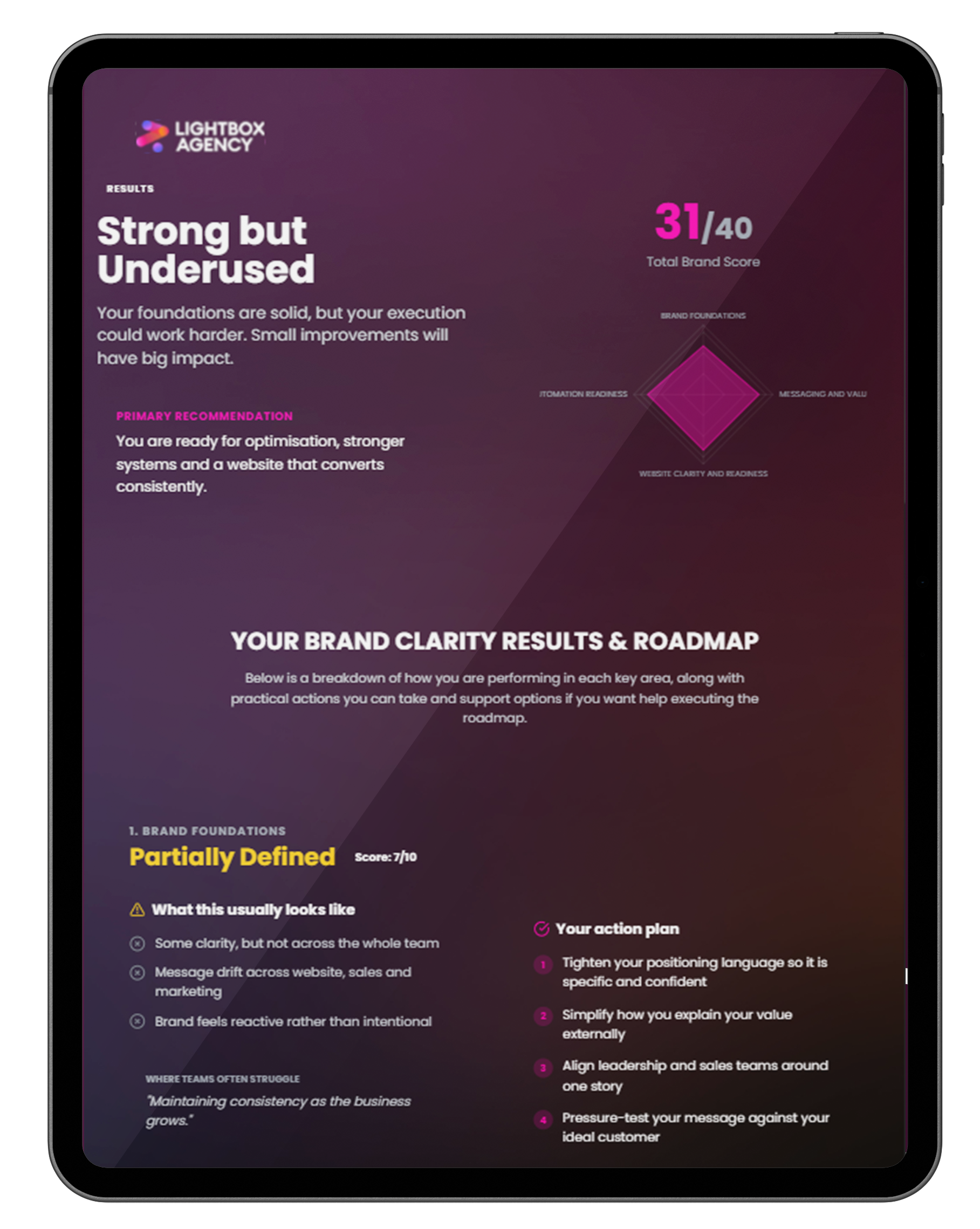
.png&w=3840&q=75)